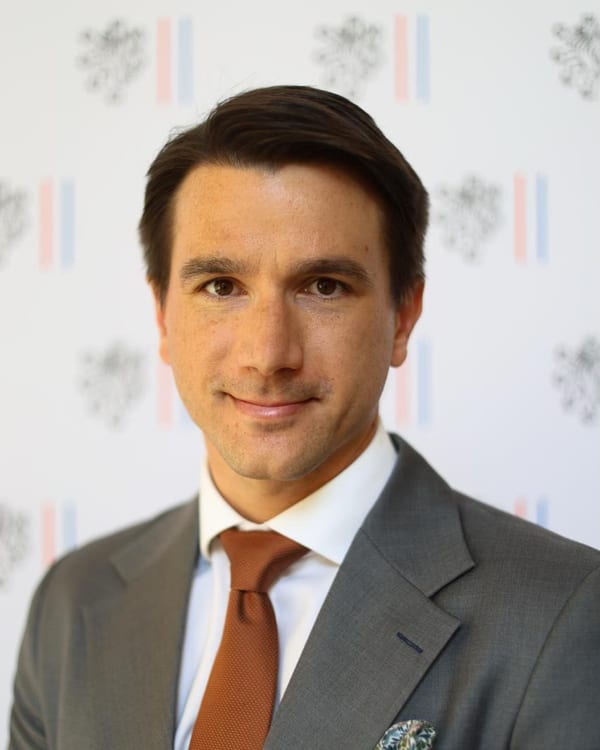
Our guest today is David Vaverka, Head of the Economic and Commercial Section at the Embassy of the Czech Republic in Pretoria, where he covers economic and commercial relations with South Africa, Botswana, Eswatini, Lesotho and Namibia. His work sits at the practical end of diplomacy, connecting Czech companies with opportunities across sectors from mining technology to renewable energy, and writing regularly on South Africa's economic outlook for Czech exporters. We're speaking with him just as Czechia and South Africa conclude the sixth session of their Joint Committee on Economic Cooperation, which makes this a good moment to ask what a deeper Europe-Africa partnership actually looks like in practice, beyond the headline trade figures. David, welcome to CSA Insights.
Getting to know you
From your desk in Pretoria, you cover economic relations with five countries: South Africa, Botswana, Eswatini, Lesotho and Namibia. What's the biggest thing that surprised you once you were actually on the ground?
What surprised me most and still does after almost nine years in the region, is how open and approachable people are. I first came to South Africa to work on a community entrepreneurship project in Cape Town's townships, then on a large Czech manufacturing investment, and only later joined the Ministry of Foreign Affairs. Along the way I have lived in Cape Town, Johannesburg and Pretoria and spent a lot of time in Durban, and I have dealt with everyone from street vendors to members of government. Whatever the setting, private sector, public sector or a chance conversation, people are genuinely approachable.
The flip side, and the lesson I pass on to every Czech company, is that approachability is only the starting point. Every meaningful relationship I have here was built over time, in person, on trust. It is very difficult to move a project forward from a desk somewhere else, and that applies even more to the countries where we have no resident embassy.
The other surprise was how familiar South Africa's business environment feels to someone from Czechia. Botswana, Eswatini, Lesotho and Namibia look different on the surface, but they are so closely interlinked with South Africa that they are, in many ways, fundamentally similar.
Czechia and South Africa, right now
This conversation happens right as the 6th Session of the Czechia-South Africa Joint Committee on Economic Cooperation wraps up, with Deputy Minister Steenhuisen chairing on the South African side. Without the diplomatic language, what actually came out of it? What's genuinely new, versus what's a repeat of previous sessions?
To answer it straight: the most important outcome is not one headline agreement, but concrete projects moving forward across a range of sectors, at various stages, on the back of genuinely growing interest on both sides.
The Joint Committee is essentially a stocktaking and objective-setting exercise between our two ministries responsible for industry and trade. This session covered trade and investment, mining and chemicals, energy, transport, the defence industry, agriculture and food, science and innovation, and tourism. An action plan will follow to turn the outcomes into concrete steps.
Two tangible results stand out. The Czech Extraction and Mining Technology Association (CDT) and its South African counterpart MEMSA signed a memorandum to support local production of mining equipment and components in South Africa. And Mintek, South Africa's state minerals research institution, is formalising a strategic partnership with a leading Czech company in the chemicals and mining sector. Industrial cooperation in the defence industry is also strengthening rapidly.
What is genuinely new is the mindset. It is not an empty phrase to say that our companies mostly complement rather than compete with each other, and that is increasingly being realised in practice.
South Africa's own government describes Czechia as its ninth-largest EU trading partner, with bilateral trade around $1.1 billion. From where you sit, is that number a story of steady, healthy growth or is it well below what it could be, given what both economies actually offer each other?
The trade figure only captures part of the story. Equally important, if not more so, is investor interest and sentiment, and speaking for Czech investors, that has clearly been growing. Our economy is remarkably diverse and so are Czech investments in South Africa, with fintech in particular attracting increasing amounts of Czech capital.
On trade itself, the number has been higher. A few years ago it reached around EUR 1.5 billion. Disruption of global value chains has played a role, and so have the shifts in the automotive industry, which features very strongly on both sides of our trade. When automotive moves, our numbers move with it.
The encouraging part is how much room there is to grow. Trade studies suggest that, in relative terms, Czechia offers South Africa the largest scope to expand its exports of any EU country. That is exactly why our ministries of industry and trade are now working with a list of 50 priority export products, to turn that opportunity into concrete business.
Trade and investment, in practice
Czech companies here are active in renewable energy, mining technology, boat building, non-woven fabric manufacturing or hospitality, a fairly diverse mix. Which of these has actually worked better than expected, and is there a common thread in why those particular companies succeeded in the South African market?
To be honest, practically every Czech company that has truly committed itself to South Africa has done reasonably well, especially considering the current geopolitical context and the long-running disruption of logistics routes.
If I had to single out one area, it would be fintech. South Africa has been producing highly successful start-ups in that space, and its financial services sector is genuinely world class. It has been drawing not only Czech attention but increasingly Czech capital.
The common thread among those who succeed is full commitment and presence on the ground. South Africa is a large market with significant influence across the region, and as the most diverse and industrialised economy on the continent, its competitive environment is very similar to Europe's. So it comes down to how serious a company is about succeeding here. For those who are, the rewards are real: capital markets are liquid and returns are attractive compared with many European markets.
If a Czech company came to you tomorrow asking whether to enter the South African market, what's the one obstacle you'd warn them about first? Regulatory, logistical, or something people don't expect until they're already here?
Since logistics came up, it is definitely a factor to plan for. The security situation in the Red Sea and around Suez has added a risk premium to shipping between Europe and southern Africa. On top of that, South Africa's ports can be a bottleneck, and well over 95 percent of non-bulk cargo moves by road, which adds cost and complexity.
But the obstacle I would warn about first is a less visible one: underestimating the importance of personal relationships. Business here runs on trust, and building meaningful partnerships takes real investment of time. That is very hard to do without frequent visits or, ideally, a permanent presence on the ground.
Let me also flip the question, because there is one hugely underappreciated advantage of doing business with South Africa: the time zone. Pretoria is just one hour ahead of Prague in the European winter, and in the same time zone in summer. Compared with Asia or the Americas, that makes day-to-day cooperation remarkably easy.
Europe, Africa and the wider region
The visit that brought Deputy Minister Steenhuisen to Prague this week also covers Poland and Germany and the stated goal includes South African exports into the EU under the SADC-EU Economic Partnership Agreement. Where does a country the size of Czechia actually have leverage in that picture, versus just following what Brussels and the bigger EU economies negotiate?
First, the basics: we all benefit from the tariff reductions under the EU-SADC Economic Partnership Agreement. Full stop. The current trend of using trade as a weapon may try to convince us otherwise, but history shows that everyone benefits most when tariffs are reciprocally low. Tariff wars are a net loss for everyone.
I won't pretend that Czechia has a major voice in shaping EU trade policy, which is negotiated in Brussels and where larger member states such as Germany naturally carry more weight.
That doesn't mean Czechia has little to offer bilaterally. Quite the opposite. As I mentioned, our companies are highly complementary. Both our economies are diverse, and each of us acts as a gateway to its own region: South Africa to southern Africa, Czechia to Central Europe. On top of that, Czech industry is technologically advanced and offers a level of customisation and care that is often hard to match.
South Africa is often described, including in your own writing, as a gateway into the rest of the continent. Covering also Botswana, Eswatini, Lesotho and Namibia yourself, does that “gateway” idea actually hold up in practice, or do Czech companies need a completely separate strategy for each of those markets?
As I mentioned earlier, the other four markets may look very different from South Africa on the surface, but they are deeply interconnected with it. Most of their imports come from South Africa, and Eswatini, Lesotho and Namibia even have their currencies pegged one to one to the rand. All four are members of both SADC and the Southern African Customs Union with South Africa.
Of course, each has its own business environment and specificities, and companies should respect that. But I fully stand behind the idea that South Africa is the gateway to the region. In practice, it still very much applies: a company that establishes itself properly in South Africa is already well positioned to reach its neighbors.
CSA's readers mostly come from a cybersecurity and digital-economy background. Do the topics such as Czech IT, cybersecurity or digital-identity companies, or South African interest in Czech expertise there ever cross your desk, or is the relationship still overwhelmingly about traditional sectors like mining and manufacturing?
ICT and cybersecurity are an inherent part of almost everything in this digital age, so the answer is naturally yes. I deal with Czech companies from this sector frequently, and quite a few of them are already active on the South African market.
Czechia is a very strong player in this field. We have produced globally successful solutions such as Avast and AVG, both born in Czechia and used by hundreds of millions of people worldwide. A lot of that strength comes from being under constant cyber pressure ourselves, which has forced us to become very good at defending against it.
Czech solutions also come with a reputation for trustworthiness and no strings attached. In today's world, that is increasingly rare and valuable.
Looking ahead
Imagine five years from now. What single, concrete change in the Czechia-South Africa relationship, not just a bigger trade number, would tell you that this partnership had genuinely deepened, rather than just continued as usual?
I would like to see more of those naturally complementary partnerships turned into reality. Concretely, that means more Czech businesses with a permanent presence on the ground in South Africa, and more South African businesses in Czechia. The real sign of success would be Czech and South African companies building things together and selling them to third markets, rather than simply trading with each other.
And at the political level, I want Czechia to be firmly on the radar of senior officials across the countries I cover, as a capable and obvious partner. If, in five years, a minister in the region facing a challenge in energy, mining or transport thinks of Czechia as one of the first countries to call, I will know the partnership has genuinely deepened.